Third HarvestThird Harvest
Back
The Duwamish River in King County, Washington, between green banks in June

First Nations · The Duwamish

Chief Seattle signed first. No reservation was ever set aside for his Duwamish people, and they are still not federally recognized. On June 13, 2026, they took ownership of 3.56 acres at the Heron’s Nest in West Seattle. This is the record, with every source linked.

ShareXFacebook

Photo: Steven Pavlov, CC BY-SA 4.0

The Duwamish homeland is Seattle and the lower Duwamish watershed, not the Olympic Peninsula, so the Duwamish are not among the nine Peninsula nations on our First Nations page. We tell their story here because it shows, as plainly as any, how treaty promises, neighbors and recognition rules decide who holds land. Facts are stated as the linked records state them. Where Third Harvest draws its own conclusion, it is marked “Our view.”

The first signer

Black-and-white studio photograph of Chief Seattle as an elderly man with shoulder-length hair, seated, wearing a light shirt with a blanket over his lap and holding a hat, beside a pedestal and a curtain
Chief Seattle (si’ahl), photographed by E. M. Sammis in Seattle, 1864, the only known photograph of him. Buerge dates the sitting to 1865. Original print at the Museum of History & Industry, Seattle. Photo: E. M. Sammis, 1864, public domain, via Wikimedia Commons.

Chief Seattle, si’ahl in Lushootseed, was born in the 1780s and died in 1866 (HistoryLink 5071). His father, Schweabe, was Suquamish, and his mother, Scholitza, was Duwamish (HistoryLink 5071; Suquamish Museum); the Duwamish Tribe gives their names as Shweabe and Sholeetsa (duwamishtribe.org). Accounts of his birthplace differ. The Duwamish Tribe writes that he is said to have been born at his mother’s village of Stukw on the Black River, in what is now Kent; historian David Buerge writes that he told settlers he was born on Blake Island (duwamishtribe.org; Buerge).

The Duwamish Tribe writes that because descent was counted through both parents, he inherited his position as a Duwamish chief from his maternal uncle, grew up speaking both the Duwamish and Suquamish dialects of Lushootseed, and built an alliance between his parents’ two nations (duwamishtribe.org). HistoryLink writes that his parents’ ancestry meant he was “related and recognized on both sides of Elliott Bay and up the Duwamish River,” and that by the time settlers arrived, most of the Native people from the Cedar River and Shilshole Bay to Bainbridge Island and Port Madison accepted him as headman or chief (HistoryLink 5071).

Buerge writes that Governor Isaac Stevens recognized his importance and that, because of his age and prestige, he served as the Native spokesman at the Point Elliott treaty council (Buerge). On January 22, 1855, he was the first Native signer, as “Seattle, Chief of the Dwamish and Suquamish tribes” (treaty text). The official council minutes record him speaking only twice, both times in brief pledges of friendship, with no objection about land or payment (Hazard Stevens, 1900; Clark, Prologue, 1985). Buerge writes that the treaty kept a reservation for his Suquamish but none for the Duwamish; unhappiness over the treaties led many Duwamish to repudiate his leadership (Buerge). In HistoryLink’s words, “the treaties did not provide all that Seattle expected (there was no separate reservation for his Duwamish relatives, for example)” (HistoryLink 5071).

During the fighting of 1855–56 he stayed across the Sound at Port Madison and brought as many of his people there as he could (HistoryLink 5071). Afterward he petitioned the governor to hurry ratification of the treaty (Buerge), which the Senate did not ratify until March 8, 1859 (treaty text). He lived on the Port Madison Reservation, one of the four tracts the treaty reserved, at Old Man House, the Suquamish Big House on the beach at Suquamish on Agate Passage (treaty text; HistoryLink 5071; Suquamish Tribe). When the town of Seattle barred permanent Native houses in 1865, Buerge writes, he had to leave the place on Elliott Bay where he had welcomed the first settlers, though he kept visiting the town (Buerge; HistoryLink 10979).

While the treaty still waited on Congress, he spoke to Indian agent Simmons; as his words were recorded and later printed, he said: “Oh, Mr. Simmons, why don’t our papers come back to us? You always say you hope they will soon come, but they do not. I fear we are forgotten, or that we are to be cheated out of our land. I have been very poor and hungry all winter, and am very sick now. In a little while I will die. I should like to be paid for my land before I die” (Humphrey, 1906). Historian Peter Stekel dates the statement to about 1858 and writes that the text is preserved in the National Archives (HistoryNet). The record survives in more than one version, with small differences in wording.

In his last years, HistoryLink writes, he mostly stayed home on the reservation, dealing with overcrowding, disease and traveling whiskey sellers. Suquamish elder Wilson George recalled in 1954 that his mother took food to the elderly si’ahl at Old Man House, and that Sam Snyder brought him fresh water every day (HistoryLink 5071).

He died on the reservation on June 7, 1866, of a severe fever, and was buried with Catholic and Native rites in the cemetery at Suquamish (HistoryLink 5071; Suquamish Museum). Buerge gives the date as June 6 and writes that his death went unreported in the city named after him (Buerge). In about 1890 a group of Seattle residents placed a stone marker on the grave, and in 2011 the Suquamish Tribe rebuilt the gravesite monument (HistoryLink 5071; Suquamish Tribe).

The speech most often quoted in his name is not a contemporary record. Henry A. Smith published it “from notes” in the Seattle Sunday Star on October 29, 1887, nearly 35 years after it was reportedly given, and no contemporary account of it survives (HistoryLink 5071). The best-known modern environmental version was written by screenwriter Ted Perry in 1970 (Buerge). Because its wording is disputed, it is not quoted here as his words.

The treaty

On January 22, 1855, Chief Seattle (si’ahl) signed the Treaty of Point Elliott first among the Native signers, as chief of the “Dwamish and Suquamish tribes” (treaty text). The Duwamish Tribe writes that its people gave up more than 54,000 acres, land that now includes Seattle, Renton, Tukwila, Bellevue and Mercer Island, in return for a reservation and other benefits (duwamishtribe.org).

The treaty itself names no Duwamish reservation. It reserves four tracts, at Port Madison, Tulalip Bay, Perry’s Island and the Lummi River, plus a township at Tulalip as a general reservation, and allows the President to “consolidate them with other friendly tribes or bands” (Articles 2, 3 and 7). The reservation on the Black River, near where it met the Cedar and Duwamish rivers at Renton, was a later proposal: in 1866 the Superintendent of Indian Affairs asked for one to correct deficiencies in the treaty, and a petition from King County settlers stopped it (HistoryLink 2955). The Duwamish Tribe describes that reservation as promised and blocked (duwamishtribe.org).

Instead, Duwamish families went to the Port Madison Reservation with the Suquamish, to Tulalip, Muckleshoot and Lummi, or stayed near their old villages (Suquamish Tribe; Federal Register, 2015). Those who stayed were pushed out of the town by ordinance in 1865, and the Duwamish Tribe writes that the U.S. Army and settlers burned their longhouses so they could not return (HistoryLink 10979; duwamishtribe.org). In 1916 the Black River itself disappeared when Lake Washington was lowered for the Ballard Locks (Seattle Times).

What the treaty and officials said

  1. Chief Seattle signs first, for the “Dwamish and Suquamish tribes.”(Treaty text)
  2. Article 2 reserves four tracts, including one at Port Madison. Article 3 reserves a township at Tulalip as a general reservation.(Treaty text)
  3. Article 4: the tribes agree to move to those reservations. Article 7: the President may “consolidate them with other friendly tribes or bands.”(Treaty text)
  4. The Duwamish Tribe writes that it gave up over 54,000 acres “in return for the reservation and other benefits promised in the treaty.”(duwamishtribe.org)
  5. In 1866 federal officials propose a Duwamish reservation on the Black River.(HistoryLink 2955)

What happened

  1. No reservation is ever set aside for the Duwamish. The treaty text names none on the Duwamish, Black or Cedar rivers.(Treaty text)
  2. Duwamish families go to Port Madison (Suquamish), Tulalip, Muckleshoot and Lummi, or stay near their homes.(Seattle Times)
  3. In 1865 Seattle bars Native people from living in town unless an employer houses them.(HistoryLink 10979)
  4. In 1866 a settlers’ petition stops the Black River reservation. In 1916 the Black River itself is gone.(HistoryLink 2955)
  5. Before 2026 the tribe owned less than 5 acres inside Seattle, mostly the longhouse and its parking.(West Seattle Blog)
Promised and proposed, against what happened. Each line links to its source.

Timeline, 1855 to 2026

  • Treaty, Congress, Interior and courts
  • Settlers and the town
  • Neighboring nations
  • The Duwamish
  1. January 22, 1855Treaty, Congress, Interior and courts

    The Treaty of Point Elliott is signed at Muckl-te-oh (Point Elliott, near Mukilteo). The first Native signature is “Seattle, Chief of the Dwamish and Suquamish tribes,” and three Duwamish sub-chiefs also sign: Ts’huahntl, Now-a-chais and Ha-seh-doo-an. The treaty reserves four tracts and a general reservation at Tulalip. None is set aside for the Duwamish on their own rivers.

    Source: Treaty text; duwamishtribe.org

  2. 1857Treaty, Congress, Interior and courts

    After the 1855–56 war, the United States creates the Muckleshoot Reservation for people of the upper White and Green rivers in the Duwamish watershed.

    Source: Seattle Times

  3. March 8, 1859Treaty, Congress, Interior and courts

    The Senate ratifies the treaty.

    Source: Treaty text

  4. February 7, 1865Settlers and the town

    Seattle’s Board of Trustees passes Ordinance No. 5, barring Native people from living in the town unless a non-Native employer housed them.

    Source: HistoryLink 10979

  5. June 7, 1866The Duwamish

    Chief Seattle dies on the Port Madison Reservation at Suquamish and is buried in the reservation cemetery there. Buerge gives the date as June 6.

    Source: HistoryLink 5071; Suquamish Museum; Buerge

  6. 1866Settlers and the town

    The Superintendent of Indian Affairs proposes a reservation on the Black River “to correct deficiencies in the Point Elliott Treaty.” About 156 King County settlers petition Delegate Arthur Denny against it, and the reservation is not established.

    Source: HistoryLink 2955; duwamishtribe.org

  7. 1893Settlers and the town

    Settlers burn Herring’s House, the Duwamish winter village at the mouth of the Duwamish River.

    Source: HistoryLink 10979; Seattle Times

  8. 1916Treaty, Congress, Interior and courts

    The Black River disappears when Lake Washington is lowered about 9 feet for the Ballard Locks.

    Source: Seattle Times

  9. 1925The Duwamish

    The tribe adopts the constitution it is still governed by and sues the United States; it wins a judgment on its claims in 1934.

    Source: duwamishtribe.org

  10. June 7, 1977The Duwamish

    The Duwamish file a letter of intent to petition for federal acknowledgment (Petition #025).

    Source: BIA; BIA #025

  11. 1979Treaty, Congress, Interior and courts

    In United States v. Washington (Washington II), the district court rules that the Duwamish and four other groups are not political successors to the treaty tribes for fishing rights. Affirmed 1981; review denied 1982.

    Source: Court order, 2025; Seattle Times

  12. June 28, 1996Treaty, Congress, Interior and courts

    Interior publishes a proposed finding against acknowledgment.

    Source: Federal Register

  13. January 19, 2001Treaty, Congress, Interior and courts

    The BIA announces a final determination to acknowledge the Duwamish, to take effect 90 days after publication. It is never published; Interior later describes the document as a draft decision.

    Source: BIA press release; Federal Register, 2015

  14. September 25, 2001Treaty, Congress, Interior and courts

    Interior issues a final determination against acknowledgment. It becomes final on May 8, 2002.

    Source: Federal Register, 2001; Federal Register, 2015

  15. 2008Neighboring nations

    The Duwamish sue in federal court (May 7, 2008). The Muckleshoot Indian Tribe moves to intervene against them; the court denies intervention and admits the Muckleshoot as amicus curiae.

    Source: Federal Register, 2015; Court order, 2022

  16. March 22, 2013Treaty, Congress, Interior and courts

    The court vacates the 2001 decision and sends it back to Interior.

    Source: Federal Register, 2015

  17. July 2015Treaty, Congress, Interior and courts

    Interior again declines acknowledgment, finding the petitioner met four of seven criteria but not (a), (b) and (c). The decision addresses “Muckleshoot’s allegation” that some Duwamish members and leaders may be enrolled in federally recognized tribes.

    Source: Federal Register, 2015

  18. 2019Treaty, Congress, Interior and courts

    The Interior Board of Indian Appeals upholds the denial in April, and the Secretary in July.

    Source: Seattle Times; BIA #025

  19. April 2, 2022Neighboring nations

    The Suquamish Tribal Council publishes its opposition to recognition of the Duwamish by Congress. It says it took no position in the Interior process.

    Source: suquamish.nsn.us

  20. May 11, 2022The Duwamish

    The Duwamish file a new lawsuit against the Department of the Interior.

    Source: duwamishtribe.org

  21. 2022Neighboring nations

    Leaders of the Muckleshoot, Suquamish, Tulalip and Puyallup tribes tell the Seattle Times they strongly oppose recognition. The Muckleshoot, Tulalip and Puyallup run a joint campaign site against it.

    Source: Seattle Times; therealduwamish.org

  22. September 6, 2022Neighboring nations

    The court again denies the Muckleshoot’s motion to intervene and admits it as amicus. The Muckleshoot and Tulalip both take part as amici.

    Source: Court order, 2022; Court order, 2025

  23. January 30, 2025Neighboring nations

    The court sends the petition back to Interior to be considered under the 2015 rules with new evidence. The Muckleshoot and Tulalip had filed briefs opposing that remand.

    Source: Court order, 2025

  24. NowTreaty, Congress, Interior and courts

    The BIA lists Petition #025 as “Supplementing Doc. Petition”: “The Department is waiting for the petitioner to supplement its documented petition.”

    Source: BIA #025

  25. June 13, 2026The Duwamish

    The Duwamish Tribe takes ownership of 3.56 acres at the Heron’s Nest in West Seattle.

    Source: West Seattle Blog; Underscore Native News

Recognition

The decisions on Duwamish recognition were made by the Department of the Interior and the federal courts. The opposition on record before those bodies, and in public, has come from neighboring federally recognized tribes, several of which count many Duwamish descendants among their citizens. Each entry below is limited to what the linked record shows.

Interior’s own reasons, in its 2015 decision, were that the petitioning group formed in 1925, that its ancestors were mainly Duwamish women who married settlers and did not go to the reservations, and that it had not shown continuous community and political authority. About 99 percent of its members on the 1992 list descend from historical Duwamish Indians (Federal Register, 2015).

Muckleshoot Indian Tribe

What it did

Moved to intervene against the Duwamish in federal court in 2008 and again in 2022; both times the court denied intervention and admitted it as amicus. In 2025 it filed a brief opposing the remand to Interior. In the Interior process it alleged that some Duwamish members and leaders may be enrolled in federally recognized tribes.

Its stated reasons

Its 2022 motion cites the 1979 ruling that the Duwamish are not a treaty successor, its “exclusive tribal access to fresh water fishing places in the Duwamish River drainage and Lake Washington,” its treaty share of fish there, and cultural property. Chairman Jaison Elkins told the Seattle Times: “We are opposed to them because they are stealing our history and culture and our stories and appropriating them for themselves,” and said the opposition is not about economic competition.

Sources: Motion, 2022; Court order, 2022; Court order, 2025; Federal Register, 2015; Seattle Times

Tulalip Tribes

What it did

Admitted as amicus in the 2022 lawsuit, and filed a brief opposing the 2025 remand. Part of the joint campaign site against recognition.

Its stated reasons

With the Muckleshoot, it argued that the 1979 Washington II ruling had already decided the Duwamish are not the successor to the treaty-signing tribe. The court noted the Ninth Circuit held that ruling does not bar recognition.

Sources: Court order, 2025; therealduwamish.org

Puyallup Tribe

What it did

Named by the Seattle Times among the tribes whose leaders strongly oppose recognition, and part of the joint campaign site.

Its stated reasons

The campaign site says most Duwamish descendants are citizens of the Muckleshoot, Puyallup, Tulalip, Suquamish and Lummi tribes, and calls the Duwamish organization “not an Indian Tribe.”

Sources: Seattle Times; therealduwamish.org

Suquamish Tribe

What it did

Opposes recognition by Congress (statement of April 2, 2022). It states that it “did not take a position” when the Duwamish made their case before Interior.

Its stated reasons

It says more than half its citizens are Duwamish people, including a majority of its seven-member council, and that Duwamish chairwoman Cecile Hansen is a Suquamish citizen; that the “host Tribe for Seattle” claim discounts other area tribes; and that Duwamish leaders would not assure it that its Duwamish citizens could join a recognized Duwamish tribe.

Sources: suquamish.nsn.us; Seattle Times

Chairwoman Cecile Hansen, herself enrolled at Suquamish, answered in 2022: “We are not in any big battle with them. We are just trying to correct the injustice of not being acknowledged by the federal government… We don’t want anything from them” (Seattle Times).

Land returned, 2026

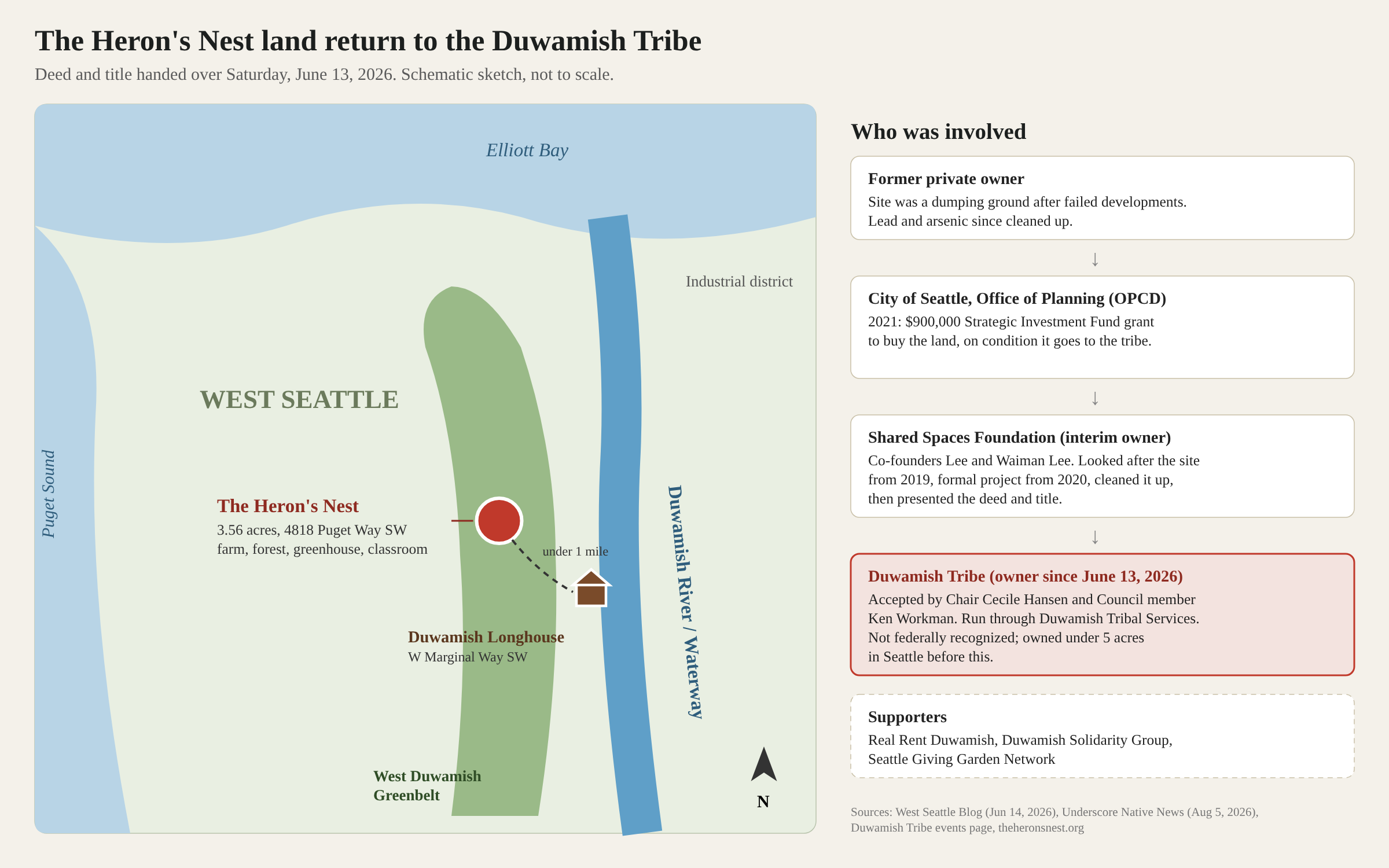
On Saturday, June 13, 2026, the Shared Spaces Foundation presented the deed and title to 3.56 acres in the West Duwamish Greenbelt to the Duwamish Tribe, less than a mile from the Duwamish Longhouse. Chair Cecile Hansen and Council member Ken Workman, a descendant of Chief Seattle, accepted it (West Seattle Blog; Underscore Native News; duwamishtribe.org). The site, the Heron’s Nest, is at 4818 Puget Way SW (theheronsnest.org). The Duwamish describe themselves as the host tribe for Seattle (duwamishtribe.org); the Suquamish Tribe disputes that description (suquamish.nsn.us).

Before this the tribe owned less than 5 acres inside Seattle, mostly the longhouse and its parking, out of about 54,000 acres of ancestral land lost in the 1800s; outside the city it bought 33 acres near Renton the year before (West Seattle Blog). It came back without federal recognition, and while neighboring nations continue to oppose that recognition (above).

2019–2020

Shared Spaces co-founder Lee began looking after the property for its owner in 2019 and opened talks with the tribe; the Heron’s Nest project formally began in 2020.

Source: West Seattle Blog

2021

The City of Seattle gave Shared Spaces a $900,000 Strategic Investment Fund grant to buy the land, with the promise that it would be given to the Duwamish Tribe.

Source: Underscore

Cleanup

Lead, arsenic and other materials dumped by previous owners were cleaned up; the site is off the Department of Ecology’s contaminated sites list.

Source: Underscore

Today

An urban farm and forest, a 65-foot greenhouse and an outdoor classroom. Each spring about 5,000 vegetable starts go to schools, food banks and tribal members.

Source: Underscore

Duwamish Tribal Services, the tribe’s nonprofit, has grown from two full-time employees to ten, including a full-time manager for the Heron’s Nest, and manages more than 50 acres of the West Duwamish Greenbelt in partnership with the City (Underscore Native News).

“A long time ago the Duwamish people lived here, and then they were told they were not allowed. But now we are back.”
Ken Workman, Duwamish Tribal Council member and descendant of Chief Seattle, June 13, 2026. Source: West Seattle Blog
“To me, it seems like a huge piece of property because we are not federally recognized and do not have a reservation. So any land that we do get is a huge event.”
Nancy Sackman, vice chair, Duwamish Tribal Council. Source: Underscore Native News
“We didn’t go anywhere. You just think you don’t see us.”
Nancy Sackman. Source: Underscore Native News
“We raise our hands to everyone who envisioned and followed through with this historic and generous Heron’s Nest project, a truly generous gift of land that our tribal ancestors and members, plus our welcome guests, have and will enjoy… We will continue to heal and nourish this land using our traditional cultural practices to benefit our members, the larger community, and future generations.”
Cecile Hansen, Chairwoman, Duwamish Tribal Council. Source: Underscore Native News
Schematic map, not to scale: the Heron's Nest in the West Duwamish Greenbelt in West Seattle, less than a mile from the Duwamish Longhouse on West Marginal Way SW beside the Duwamish River, with Elliott Bay to the north. Beside it, the chain of ownership: former private owner, City of Seattle grant in 2021, Shared Spaces Foundation as interim owner, and the Duwamish Tribe as owner since June 13, 2026.
Schematic sketch, not to scale. Drawn by Third Harvest from the sources listed on it. Tap to open full size.

A connecting thread

The Duwamish are not the only case where the actions of neighboring nations, alongside the government’s, shaped who kept land and who was recognized. The facts below are from the linked records; Third Harvest’s reading follows each.

Duwamish

Interior denied recognition in 2001 and 2015. The Muckleshoot and Tulalip took part in the court cases against it, and in 2025 opposed even a fresh review (court order, 2025).

Our view: the nations that absorbed the Duwamish have also been the ones contesting their right to stand on their own.

Chinook

Interior acknowledged the Chinook in January 2001. The Quinault Indian Nation requested reconsideration before the Interior Board of Indian Appeals, and the reconsidered decision of July 12, 2002 reversed the acknowledgment (Federal Register, 2002).

Our view: a neighboring nation’s challenge is what opened the door to taking recognition away.

Chimakum

Historian David Buerge writes that Suquamish warriors under Chief Seattle, joined by S’Klallam warriors, destroyed the last Chimakum village in 1847; other accounts give other dates and attackers. The Chemakum Tribe writes that the Indian Claims Commission later awarded Chemakum territory to the S’Klallam, who claimed it had been abandoned before the treaty (chemakum.org).

Our view: it is clear that some tribes were trying to consolidate or gain power, depending on who you were. One reading of the accounts is that the attack on the Chimakum was such a move, made ahead of the treaties; the sources name S’Klallam fighters alongside the Suquamish, and it is suspected that Clallam bands whose descendants include today’s Jamestown S’Klallam took part. The usual story is “to the victor go the spoils,” but not always: here there are real Chimakum survivors seeking recognition. Treaties were made in good faith and were not honored. Rather than naming a host tribe, we should find a way to honor the land and its people by bringing the Duwamish back to their land, and some of that starts with having the hard conversations about what actually happened. The full Chimakum history.

Moving forward

Descendants of both peoples are still here, and both have said what they want. The Duwamish Tribe is pursuing federal acknowledgment again, with Interior now waiting on its supplemented petition (duwamishtribe.org; BIA), and on the land it has, its chair says, it “will continue to heal and nourish this land using our traditional cultural practices” (Underscore Native News). The Chemakum Tribe writes that in 2022 it formed a council to seek recognition, and that “we are committed to reclaiming our territory and acquiring a land base.” In its words, “We are still here” (chemakum.org).

Many other Duwamish descendants are citizens of neighboring nations today, as those nations’ own statements say (Suquamish Tribe; therealduwamish.org), and the Chemakum Tribe writes that Chemakum survivors were absorbed into various tribes (chemakum.org). Their place in those nations is real, and nothing here takes from it.

Third Harvest has no agreement with the Duwamish Tribe, the Chemakum Tribe, or any nation named here. Nothing here speaks for any tribe.

Sources

↑ Back to top